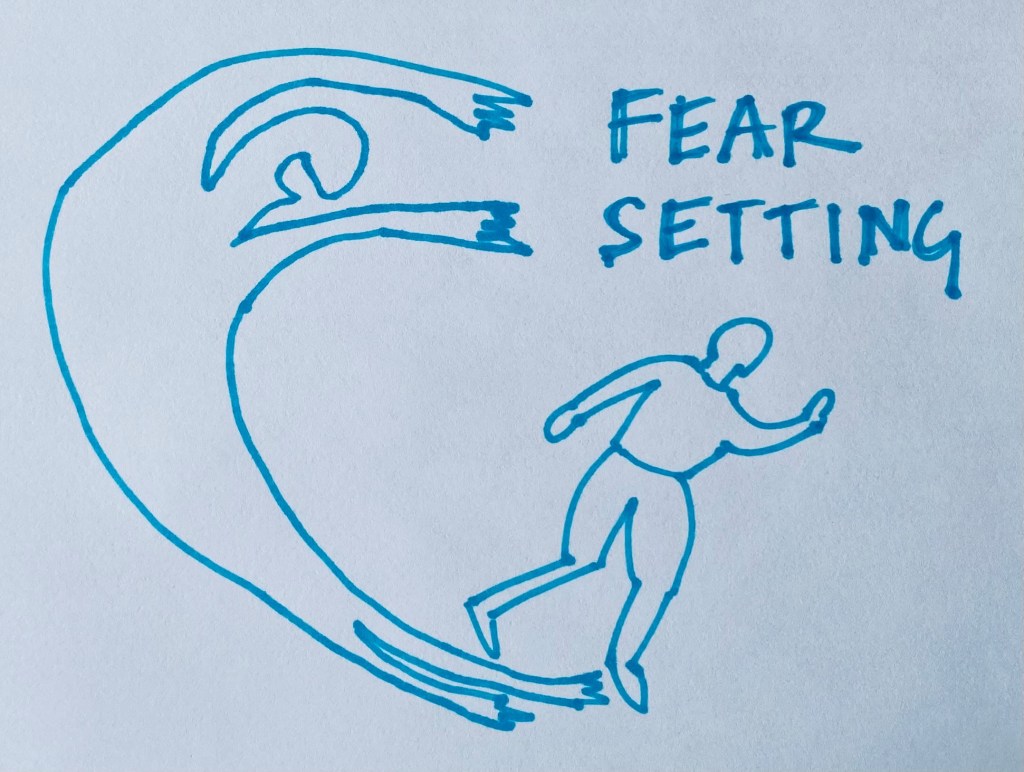
“Fear setting,” as described by Tim Ferriss and others, has been a helpful exercise to reflect on what is holding me back from doing things that feel scary. Recently, my number one scary thing is to start writing for myself again.
In brief, “fear setting” challenges you to write down the worst things that could happen if you take a step toward the scary unknown. You then note what you would do to prevent these worst things from happening, along with what actions you would take if they actually happen. The idea is to write it all out on one piece of paper and see your fears with your reasonable responses next to them. Ideally, it feels not-so-scary on paper. Tim also counsels to list the possible benefits of the action if you take it, as well as a third list of the cost of inaction if you do nothing over 6 months, 1 year, or 3 years.
It is not easy to move from frozen in fear to an embodied knowing that we perceive our scariest challenges blocked by surmountable obstacles. It is harder still to take in Tim’s point that inaction could actually cost us if we don’t attempt the fearful unknown. Especially in creative work, especially when judgement looms as a starting point for fear, even a list of “reasonable” responses to worst case scenarios can feel too fragile to inspire a beginning.
In the spirit of such fragile (re)beginnings, here are excerpts of my own fear setting work around writing again, five years after my last post:
I fear people – in the most generic sense – won’t like me because of what I write. And because I fear this type of critique, I’m disappointed in my interest in external validation in the first place. Although it’s been challenging to admit, I’ve come to understand only recently that I count on external validation to prop up my sense of self-worth. I am a huge fan of Brene Brown and her research on shame, and want to be somebody whose grounded sense of self-worthiness means they can do hard things – even in the face of critics or in the absence of validation. I want to make Brene proud! I say this with only a hint of irony, acknowledging I am not yet this person. So, even though it disappoints me and there’s shame in admitting it, I fear what other people think.
If they read what I write, I fear the people I love will realize I am not a good writer, and worse, that I’m not smart. I fear their judgement mostly as the residue of growing up with an English teacher for a father, who regularly scolded my poor use of grammar and would re-grade my school papers to ensure I knew there was room for improvement, even if the teacher gave me an A. Since my died almost two years ago and is no longer here to comment, there’s only you, dear reader. So, you should know I don’t know what an adverb is off the top of my head. I don’t have a “writer’s vocabulary,” as I am worthless without a synonym search. I make typos, I confuse “there” and “they’re,” and I haven’t used the word “affect” without googling its proper usage in years.
Deeper down, I fear my own ideas. Because I am committed to a life of learning, I feel it is a truism that I will grow and change my mind on important subjects. Will I disappoint my future self with my elementary thinking now? In my extremely limited experience writing under my own byline, I can answer with assuredness: yes. See this piece from 2013 where I imagined a wedding would “bring up a storm of emotions in both the bride and groom-to-be,” which was an incredibly heteronormative way to make a point about LGBTQ+ rights. Embarrassing. I want to know more in the future than I do now and I want to broaden my mind and how I think, which seems to mean this endeavor carries with it probability that the future me will be disappointed in what the present me writes.
More than a decade ago, I realized that fear of my dad’s judgement was driving many of my life decisions, including my reluctance to write for myself. I sought his approval to confirm my own worthiness, and over the years, internalized his judgments (or rather, my childhood view of them) as my own inner voice and worst critic. In the almost two years since he died, I have come to understand this inner voice lives on, even without him – and thus carries more weight than his. I can tell you this: she’s good at her inner critic job. It’s hard to let go of the role my dad played in my fear of writing, and challenging to realize that retiring my inner critic could take a lifetime.
Fear setting asks us to shed light on the shadows, anticipate actions to prevent our “worst case” scenarios, and think through what we would do in the event they happen. I’m finally creating space for my fears by dragging them into the light and holding them up as a necessary part of reconnecting with creativity. Brene tells us that “shame derives its power from being unspeakable.” Time will tell if speaking it here unburdens me from the fear of writing, but I did the scary thing and I am still standing.
 AMBER SHIPLEY