
Stoic Plants and Fair-Weather Flowers

Instead of beaming down from straight overhead, the sun follows a sideways path through my garden. Or rather, the earth’s rotation and our location further from the equator means it appears the sun’s traverse is slightly diagonal through the sky. Thanks to wooden fences on three sides, one part of the garden is shaded most of the day and the opposite side enjoys direct sunlight, which bounces off the fence behind it to create the ideal location for a succulent bed in our foggy San Francisco neighborhood. Most of the plants and flowers I’ve imported to this space, over the days and years, have adjusted their plant bodies to follow the sun. By this I mean they grow toward it. From my work space window, the entire garden looks like it is leaning to the right.

For many plants out back, this tilt is a full commitment. Take the dusty pink flowers with big yellow centers that recently popped up out of the moss-green ground cover: the hundred or so flowers go all in on chasing the sunlight. Their little pink petals cock to the right to get the best position throughout the day, basking in whatever warmth the spring sun provides amidst the fog. At night, they close up their flower shops and wait until dawn to start over again. I waiver between marveling at their ingenuity in getting what they want and thinking it’s slightly pathetic to show so little restraint in making their needs known to everyone else in the garden. 

Huge dinner plate succulents look like flowers but are, in fact, brilliant green leaves shaped into gorgeous florets. I brought these coveted, foot-wide plants into the garden a few years ago when I paid five bucks for three stems to a Chinese-speaking woman I found on Craigslist. We could not communicate with words, and yet we both knew I was getting a good deal. Succulents do best in sun and heat, so their success in reproducing and growing over the years is unsurprisingly supported by their growth toward the path of the sun. Unlike spring flowers, the entire plant has positioned itself in a survival lean to catch as much light and warmth as possible. As an unobjective observer, it appears to me that each stem seems to intuitively know what it needs to be its best self, to have the fullest chance at photosynthesis and survival. 

There are some plants, though, like the sage my friends gifted me from their thriving community garden plot, that seem untethered to the sun’s pattern in the sky. This sage plant took months to settle into its new home, but is now thriving in the middle of the yard in a tall, white pot I purchased to decorate our wedding venue years ago. There’s no lean, no shift to the right – leaves on the shady side look just as firm and delicious as those on the sunnier side of the pot. I love the fair-weather flowers, and I think of those full, healthy, shady side sage leaves as admirable stoics who didn’t get lucky enough to pop up out of the dirt in direct sunlight, but aren’t willing to show how they’re impacted by their distance from the sun. 

As an imperfect gardener, I have likely ignored the little plastic informational sticks from the garden store with scientific plant names and simple caretaking directions like “Full Sun” or “Partial Shade.” Of course, these days, I could download an app and have all of these details at my dirty fingertips. Instead, I prefer to plant each flower or succulent where I want it to grow in the garden and see what happens. This gardening method is not precise, but the concept of surviving where you’re rooted is the throughline in all of my gardening and garden reflections. 

And it works out for the most part. Plants, like humans, do best when they have what they need in terms of sunlight and nutrients, but often make do even when they don’t. Think of weeds growing in sidewalk cracks or gorgeous wildflowers blooming unattended along freeways. Or in my case, flowers and succulents figuring out how to maximize sunlight in my foggy backyard alongside that perfect sage plant in its tall white pot. As I write this, they’re in the garden, leaning toward the sun, living, surviving, growing.

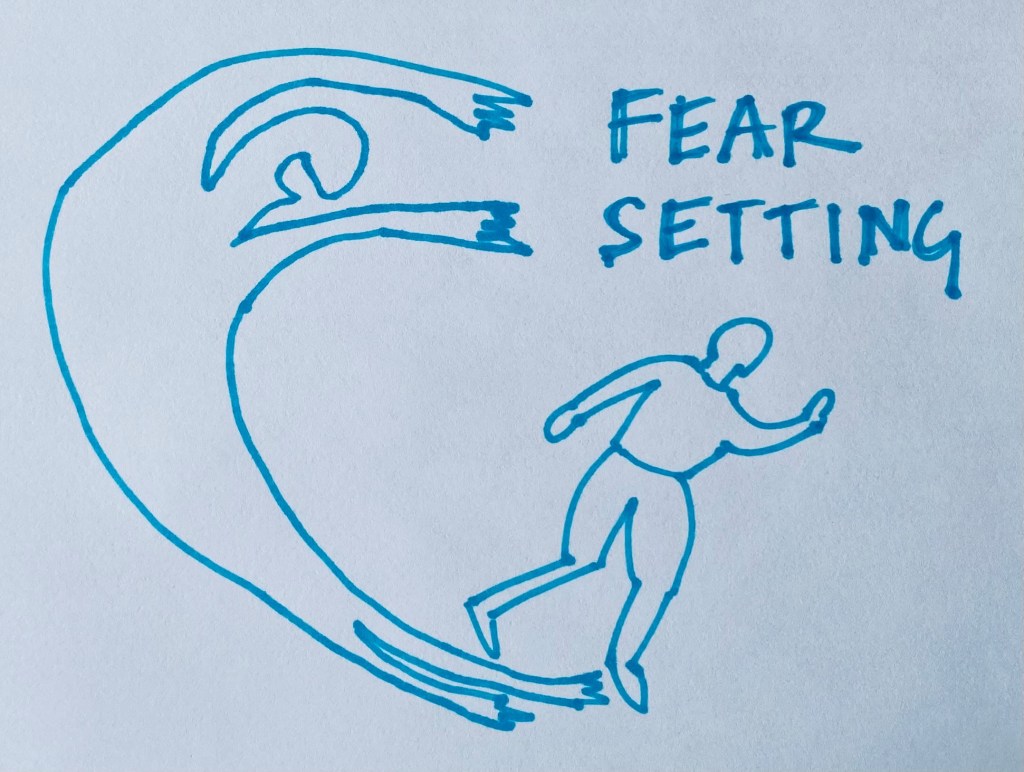
Fear Setting

“Fear setting,” as described by Tim Ferriss and others, has been a helpful exercise to reflect on what is holding me back from doing things that feel scary. Recently, my number one scary thing is to start writing for myself again.

In brief, “fear setting” challenges you to write down the worst things that could happen if you take a step toward the scary unknown. You then note what you would do to prevent these worst things from happening, along with what actions you would take if they actually happen. The idea is to write it all out on one piece of paper and see your fears with your reasonable responses next to them. Ideally, it feels not-so-scary on paper. Tim also counsels to list the possible benefits of the action if you take it, as well as a third list of the cost of inaction if you do nothing over 6 months, 1 year, or 3 years.

It is not easy to move from frozen in fear to an embodied knowing that we perceive our scariest challenges blocked by surmountable obstacles. It is harder still to take in Tim’s point that inaction could actually cost us if we don’t attempt the fearful unknown. Especially in creative work, especially when judgement looms as a starting point for fear, even a list of “reasonable” responses to worst case scenarios can feel too fragile to inspire a beginning.

In the spirit of such fragile (re)beginnings, here are excerpts of my own fear setting work around writing again, five years after my last post:

I fear people – in the most generic sense – won’t like me because of what I write. And because I fear this type of critique, I’m disappointed in my interest in external validation in the first place. Although it’s been challenging to admit, I’ve come to understand only recently that I count on external validation to prop up my sense of self-worth. I am a huge fan of Brene Brown and her research on shame, and want to be somebody whose grounded sense of self-worthiness means they can do hard things – even in the face of critics or in the absence of validation. I want to make Brene proud! I say this with only a hint of irony, acknowledging I am not yet this person. So, even though it disappoints me and there’s shame in admitting it, I fear what other people think.

If they read what I write, I fear the people I love will realize I am not a good writer, and worse, that I’m not smart. I fear their judgement mostly as the residue of growing up with an English teacher for a father, who regularly scolded my poor use of grammar and would re-grade my school papers to ensure I knew there was room for improvement, even if the teacher gave me an A. Since my died almost two years ago and is no longer here to comment, there’s only you, dear reader. So, you should know I don’t know what an adverb is off the top of my head. I don’t have a “writer’s vocabulary,” as I am worthless without a synonym search. I make typos, I confuse “there” and “they’re,” and I haven’t used the word “affect” without googling its proper usage in years. 

Deeper down, I fear my own ideas. Because I am committed to a life of learning, I feel it is a truism that I will grow and change my mind on important subjects. Will I disappoint my future self with my elementary thinking now? In my extremely limited experience writing under my own byline, I can answer with assuredness: yes. See this piece from 2013 where I imagined a wedding would “bring up a storm of emotions in both the bride and groom-to-be,” which was an incredibly heteronormative way to make a point about LGBTQ+ rights. Embarrassing. I want to know more in the future than I do now and I want to broaden my mind and how I think, which seems to mean this endeavor carries with it probability that the future me will be disappointed in what the present me writes.

More than a decade ago, I realized that fear of my dad’s judgement was driving many of my life decisions, including my reluctance to write for myself. I sought his approval to confirm my own worthiness, and over the years, internalized his judgments (or rather, my childhood view of them) as my own inner voice and worst critic. In the almost two years since he died, I have come to understand this inner voice lives on, even without him – and thus carries more weight than his. I can tell you this: she’s good at her inner critic job. It’s hard to let go of the role my dad played in my fear of writing, and challenging to realize that retiring my inner critic could take a lifetime. 

Fear setting asks us to shed light on the shadows, anticipate actions to prevent our “worst case” scenarios, and think through what we would do in the event they happen. I’m finally creating space for my fears by dragging them into the light and holding them up as a necessary part of reconnecting with creativity. Brene tells us that “shame derives its power from being unspeakable.” Time will tell if speaking it here unburdens me from the fear of writing, but I did the scary thing and I am still standing.

Top 5 Feminist Articles About Hillary Clinton from 2015

FullSizeRender

2015 was an exciting year for Hillary Clinton fans. We cheered her on as she officially launched her candidacy, ooh-ed and ah-ed as she raised a boatload of money, and breathed heavy sighs of relief when she kicked butt during the first few Democratic debates. If the polls are right, Hillary fans are ready to see her crush the competition in the upcoming Democratic primaries, and we’re ready to root her on to win it all in November. 

As I reflect back on 2015 and Hillary’s candidacy thus far, I have much to say about the missing feminist groundswell to support her campaign. Most of my feminist friends (if such categorizations can be made) are tepidly supporting her, if that. Instead of creating fun websites, blogs, and Tumblr posts in the same vein as Notorious RBG or Feminist Ryan Gosling – feeds about what an amazing feminist Hillary is and will be as our next president – it feels like many of us women’s rights supporters have stayed pretty quiet.

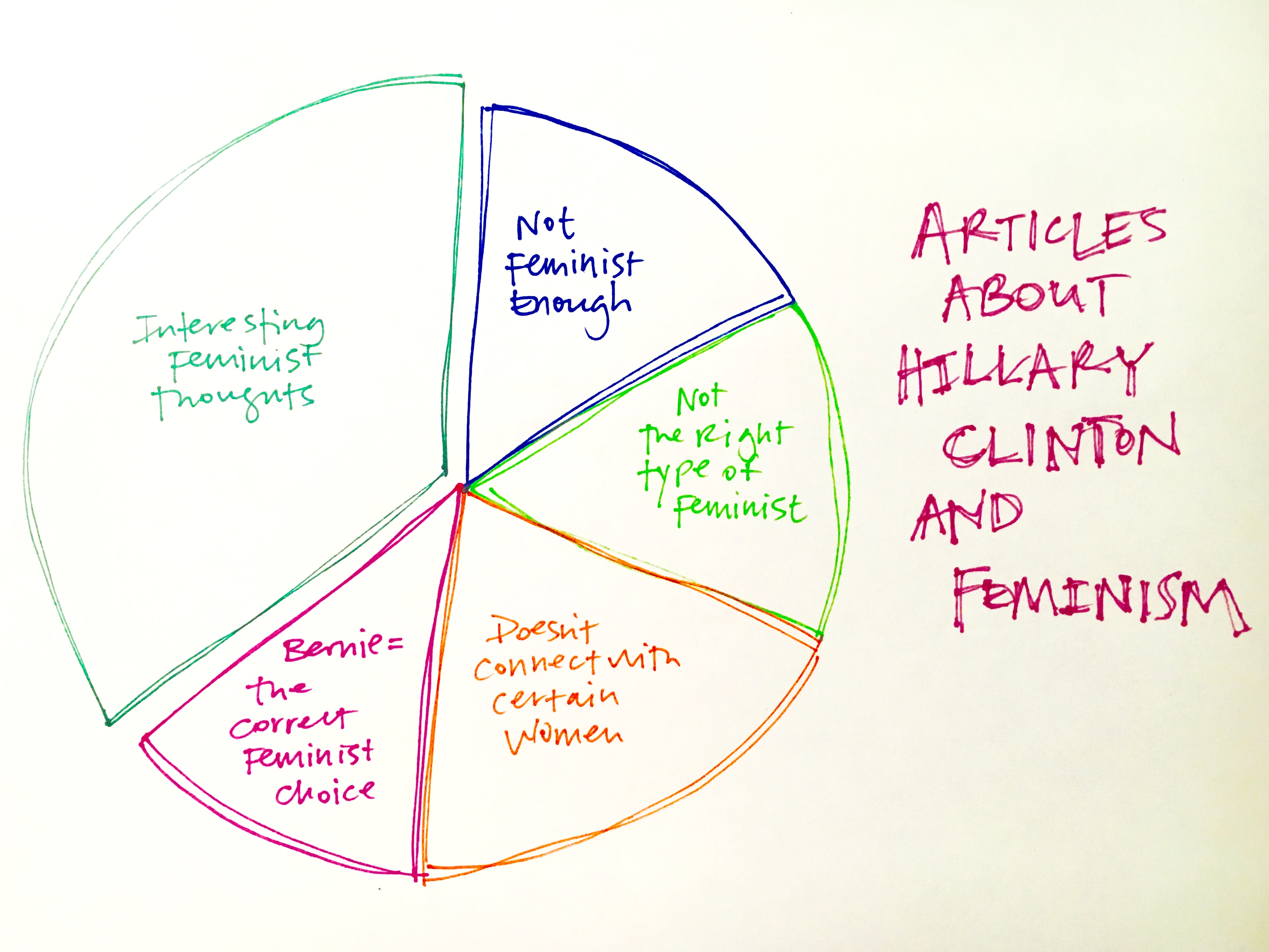
In fact, I’d wager more was written about how Hillary is not feminist enough, not the right type of feminist, not connecting with certain women, or why feminists should support Bernie Sanders than a) why feminists are excited to support Hillary and b) any feminist analyses of relevant campaign issues (e.g. sexism, sexism, and also, sexism). More on this soon.

Despite all this, I did read a handful of very compelling pieces about Hillary and feminism in 2015. So, while there weren’t oodles of them to choose, I’ve compiled a list of my top 5 feminist articles about Hillary Clinton from 2015 here:

1. Lena Dunham interviews Hillary Clinton
In the kickoff edition of Lenny http://www.lennyletter.com/, Lena Dunham and Jenni Konner’s interesting newsletter that covers feminism and politics among other topics, Dunham interviews Hillary. Here, twenty-something Dunham asks Hillary the “question on every Lenny reader’s lips: Do you consider yourself a feminist?”, allowing Hillz to answer forcefully: absolutely.

The Lenny Interview: Hillary Clinton

2. Feministing blogger Dana Bolger takes on the “Millennials hate Hillary” trope
I love Feministing, and Dana Bolger offers a great example of why it’s such a great feminist blog with her post ripping the Sunday New York Times’ “think piece” on what Bolger calls the “feminist generation war.” Bolger rightly characterizes this war—and the idea perpetuated by these types of articles that older women “get” feminism and thus support Hillary, while younger women just aren’t that smart and therefore don’t support her—as dangerous.

Dear New York Times: The Real Reason Young Feminists Reject Hillary

3. Michelle Goldberg shares her experiences as a Hillary supporter among Bernie fans
I want to pin Michelle Goldberg’s line that Bernie Sanders’ campaign has “unleashed a minor plague of progressive white men confidently explaining feminism to the rest of us” on my wall for the next time I have a conversation with someone about why supporting Hillary isn’t what feminism is about. Myokay dokay.

Men Explain Hillary to Me

4. Suzanna Danuta Walters lays out her case for supporting Hillary
The Nation is such a progressive, left-leaning publication that Suzanna Danuta Walters’ piece about why she’s supporting Hillary could actually be considered provoking in itself. Walters lays out her case for why Hillary in the White House would benefit the women’s equality movement, from policy to politics to needed culture shifts.

Why This Socialist Feminist Is for Hillary

5. Sady Doyle takes on the misogynist attacks against Hillary Clinton and questions why liking her is a subversive act
In this thought-provoking piece, Sady Doyle tackles Hillary’s “likeability” issues, telling us that liking Hillary has become a subversive act. Doyle also asks her readers how long they would make it if people treated them the way many treat Hillary. I couldn’t agree with Doyle more that it’s not fair that Hillary must “climb over a barbed-wire fence of hatred in order to change the world.”

More Than Likable Enough

So, dear readers, those are my top 5. Are there others I missed? Send them my way! And because writing it on the interwebs makes it true, in addition to building my upper body strength and meditating more, my New Years’ resolution is to help grow this list in 2016.

Why Bernie

IMG_0829

More than a few Democrats I love and respect are considering supporting Bernie Sanders in the 2016 presidential primary election. The Democratic field is all of two people, and the other candidate is a household name with exceptional political pedigree—so the decision to vote for a relatively unknown “democratic socialist” Senator from Vermont is not the path of least resistance. If you’re a Bernie fan, I assume you’ve chosen to support him because you’ve read, you’ve studied, and you’ve differentiated. If you’re on the fence, I ask that you do just a bit more reading, studying, and differentiating before you buy into “feeling the Bern.” I respectfully submit the following six questions for your consideration in this effort.

A note before we jump in: I’m a proud Hillary supporter. I have a Hillary 2016 bumper sticker and I’ve contributed to her campaign. I hope to write more over the primary season about why I support her, and why I think she’s—hands down—the best person for the job. However, this piece is not about why I’m a Hillary fan. Instead, my objective is to challenge good Democrats—folks who I believe care about our chances of actually winning in 2016—on why Bernie.

Is he an effective politician?
Bernie has been an elected official for decades, but he’s worked in Washington, D.C.—where he’d arguably need to be most effective as our next president—since 2007. In that time, he has authored and passed one substantive piece of legislation. That bill, S.893, the Veterans’ Compensation Cost-of-Living Adjustment Act of 2013, is a good one. But it’s only one bill in nine years. Per the political scientists who study these things, another measure of success on Capitol Hill is counting up how many bills an elected official cosponsors that actually become law. In these nearly 9 years, Bernie has cosponsored 33 bills that became law.

Not bad, but let’s contrast this to Hillary. She was in the Senate for about the same amount of time as Bernie—9 years—and passed 3 of her own bills, while 74 that she cosponsored became law. Of importance in this comparison, Hillary accomplished her legislative goals during W.’s tenure in the White House, and Bernie has had the privilege of working with a friendly president who would be way more inclined to sign his legislation. Speaking of Obama, he was in the Senate for 2 terms, passed 2 of his own bills, and cosponsored 29 that passed.

Bernie’s relative inability to pass legislation in Washington D.C. with a friendly president translates to a track record of ineffectiveness when you compare him to Hillary. He might be saying all the right things and you might align with his policy positions, but it’s all for naught if he can’t get anything done once elected.

Does he have friends?
After serving in one of the most prestigious institutions in American politics for nearly a decade, none of Bernie’s colleagues in the Senate have endorsed his candidacy for president. In contrast, 30 sitting Senators have come out in support of Hillary, added to a long list of governors and Members of Congress. Tellingly, Bernie’s own state delegation—both Senator Pat Leahy and Vermont Governor Shumlin—have endorsed Hillary. Bernie’s fellow Senators and his state delegation are the folks that he works most closely with—and the ones he’ll need to lean on to get anything done if his campaign is ultimately successful. With no endorsements and seemingly no friends among his colleagues, my read is that Bernie has not prioritized cultivating professional relationships that are vital to being effective as a president.

Now, I can imagine this lack of support could be perceived positively by some in the Bernie camp. Bernie’s an outsider! He doesn’t need friends in Washington, D.C.! The political elite support Hillary because they’re scared not to! Think back to Barack Obama’s first candidacy and how he created waves by “stealing” endorsements from Hillary among elected officials in Washington, D.C. Barack’s colleagues believed in his message, but they also liked him after working closely with him. They were willing to go out on a limb to endorse his candidacy because of the relationships he cultivated. All to say, it is possible to be a progressive “outsider” and also well-liked and supported by the insiders you’ll need to move forward your policy priorities as president. Bernie is not that candidate.

What do you know about him?
Even though Bernie has been on the national stage for a while, most Americans—including his supporters I’ve been talking with—know very little about him beyond policy stances and soundbites. I knew nothing, so googled “Bernie Sanders” and “family.” I found this Politico article that sheds light on Bernie’s early days in politics, wives, kids—and most importantly, disinterest in talking about his personal life.

His reticence to create a narrative around who he is as a candidate beyond the issue he cares about should be a gigantic red flag for anyone thinking this man can actually win a national election. It is unfortunate that a candidate’s personal life is important in presidential politics, but it’s our reality. The fact that Bernie has been married multiple times or had a kid out of wedlock doesn’t really set him apart from other politicians—or even most Americans—but it’s vital that he address it head on and craft a narrative that allows voters to get to know him and like him as a person. Policies are important, but they don’t win elections: people do. If you like Bernie, I’d ask questions about the man behind the message—come next year, the Republicans most definitely will.

Is he really your political kindred spirit?
If Bernie is looking good because the 2016 presidential election is all about the issues, then I’d urge you to take this short, online political quiz. It’s an over-simplified Internet game, and we can all acknowledge these aren’t exactly accurate going in, but in this instance, I think it’s an effective indicator of political kindred spirit-ness.

As an example, I’m a progressive feminist and a bleeding heart Democrat, and this quiz tells me I align with Bernie 97%… and with Hillary 96%. When there are major issues like effectiveness, character, and electability, my read is that 1% does not a kindred spirit make.

Perhaps your results see more differentiation and your Bernie score is 5% higher than Hillary. 10%? Fine. But the Democratic field is as thin as it is diverse on policy issues. We’ve got two candidates who really aren’t that far apart when it comes down to it. And policy stances being equal, I’m putting my support behind the candidate with a proven track record who is campaigning to win.

Why can he be inspirational?
He’s fired up. He’s on message. His daily emails include words like “political revolution.” I get it—Bernie’s a good, progressive candidate with a good, progressive message. And I fully admit that Hillary is often stiff and appears more scripted on the campaign trail. But could she really roll up her sleeves at a podium, hair all askew, spit flying from her mouth in a passionate rant and still be considered a viable candidate?

The answer is obviously no and the reason has to do with our different expectations of men and women politicians, particularly on the stump. Hillary is bound by expectations we don’t have of Bernie, and I think this is at play in how “inspirational” Americans are finding her as a candidate. It’s worth considering the impact of what the New Yorker’s Allyson Hobbs calls the “enthusiasm gap,” and how willing we are to consider Hillary’s candidacy in this light.

Keep in mind that great candidates can make lousy presidents, and less inspired candidates can be incredibly effective leaders. And because I can’t not say it, don’t kid yourself that well-attended speeches in progressive cities mean Bernie will win Ohio and Florida for us come November 2016.

It’s all about the money?
I’ve heard from a handful of Bernie supporters that one of the most pressing reasons to support him is his campaign against “big money” in politics and unwillingness to play the “big money game” considered necessary to win the White House. This in contrast to Hillary, who is accepting money from icky folks like lobbyists for the prison industrial complex. I could write pages upon pages about money in politics, so am offering very abridged thoughts here.

Let’s get one thing straight: it is illegal to accept a campaign donation in exchange for voting a certain way or making certain policy decisions. That’s unethical and politicians rightly go to jail for it. In addition, both Bernie and Hillary support overturning Citizens United, and both say they’ll use this policy position as a litmus test for choosing any new Supreme Court nominees. So, the real difference is how they’re fundraising.

There’s no denying that Bernie is raising lots of low-dollar donations and Hillary, while similarly fundraising amongst us low-donor types, is relying on bundlers and larger checks to hit her big time fundraising goals. She has these high dollar goals because she’s looking to win an election against a party backed by billionaires. We’re in a game of big money, and to get elected, you need to raise big money. Bernie wants to win the presidency on small-dollar donations? I want a pet unicorn and a free trip to Hawaii. Unfortunately, this election cycle, even Hillary’s efforts to fundraise via bundled contributions won’t touch the impact the other side’s super PACs will have on the race. It’s almost like Bernie is currently operating in a vacuum. While it may seem revolutionary now, in the long run it feels like either naivety or a lack of commitment to winning the race.

One other quick point: the evil prison lobbyists are professional fundraisers. They earn their paychecks in part by fundraising for candidates for elected office so they can tell their clients how much “influence” they have. But these guys aren’t really Hillary supporters. They’re just hedging their bets by contributing to the candidates they think will win—if you dig, you’ll see the same lobby shops are giving money to both sides of any given race. Right now, they’re donating to Hillary because they think she’ll win. If Bernie wins the Democratic primary, private prison lobbyists are not going to sit out the race—they will just start donating to his campaign. Will that mean that he won’t support prison reform policies? All to say, although we’d like it to be, it’s not as simple as judging a candidate by the checks they’re cashing.


My goal here was to respectfully raise the red flags I see in Bernie’s candidacy and pose questions that I’d want answered before casting my ballot for him. I’m sure there are issues I’ve missed, and positions I’ve perhaps mischaracterized. I look forward to feedback and, moreover, a robust political discussion as we move toward the Democratic debates this fall and early caucuses next year.

Note: this post was first published on fortysevenseventyeight.wordpress.com.

D.C. Reflections

As most of you readers know, your kind narrator moved from Washington, D.C. to San Francisco, CA earlier this year. Despite the California sunshine and gorgeous views, I miss a lot of my former life in D.C. and never quite adjusted to the cold fog that covers our summer months here in the Bay Area.

Though I’m happy to have created some distance from the long work hours with little effectual policy change, I do miss the people I connected with in our nation’s capital. In addition to my Washington, D.C. friends and colleagues who I think of and miss daily, I reflect equally as often and fondly on an older man who lives down the street from my house of four years in Mt. Pleasant. Strange thing is: I don’t know his name.

This older gentleman sports shoulder-length, questionably-washed silver hair and round, bookish glasses. He almost always wears worn, light denim jeans and Tevas with wool socks. I used to wonder if I liked the looks of him because he reminded me of home. He’s a dog owner, and would walk his three dogs around the block at a snails pace to accommodate one of the oldest, dirtiest terriers I’ve ever seen limp along. Sometimes my silver-haired friend would carry his coffee mug on these unhurried walks – not a to-go cup, but a thick, handmade-by-a-friend-given-as-a-gift mug. Other times, I’d see him chitchatting with neighbors while his dogs would stand patiently waiting at his side.

I’m guessing I saw this guy and his dogs nearly every other day, whether on my way to the Metro or walking home from the grocery store. As much as I was out and about in our neighborhood, he was, too. His unchanging outward appearances and habits helped me formulate a narrative of his life in my head. He was a retired architect, I reasoned, because of the round glasses. But his hands were thick and rough, which meant he spent his youth getting by on odd jobs, working with his hands. Most importantly, I had determined, he was the kind of man who was nice and good and patient with old dogs and hot summers.

About this time last year, when the leaves were finally changing and fall was bringing coolness to the air around us, I saw my neighbor at the church I sometimes attended down the street from our homes. Excited to see him somewhat out of context, I gave him my most earnest smile. He looked as if he had never seen me before and hadn’t the slightest clue who I was or why I was smiling at him.

I remember feeling the sting of disappointment that I wasn’t a memorable face to him like he was to me. But I also felt a sincere appreciation for how I could hold this person in my life with so much closeness—feel truly comforted by his routine and dependability in my life—and simultaneously keep him at arm’s length, never really talking to him or engaging at all beyond a few quiet “hello’s” as I stepped around his dogs on the sidewalk. It was a meaningful relationship for me that was completely unobtrusive, without need or time or work.

A wise friend told me recently that the comfort we seek is often available by observation of the world around us. He likened this quiet observation to a type of meditation, in that taking in your surroundings slows your mind and helps ground you in the present. I wouldn’t claim that watching an older dude walk his dog is any intense meditative work, but I like the idea of finding comfort where you can. And maybe it helps explain at least a little bit of the calmness I felt whenever I saw him around Mt. Pleasant.

As of yet in San Francisco, there is no older gentleman to watch walk his dogs each day. I’ve moved a few times within the city since arriving this spring and suppose I haven’t felt settled enough in one place to fully appreciate my neighbors’ comings and goings. Instead, I watch the trees sway in the wind and the fog roll in over the hills.

Note: this post was first published on fortysevenseventyeight.wordpress.com.
Knowing How We Know

There’s something about the experience of being in my own body that does not translate into being able to figure out what I look like. It’s an odd thing to say, but it’s my lived experience. I suppose that most of the time, I have a pretty good sense of how others see me. I hear feedback about how a dress looks or what friends think of certain jeans. I look at photos or I ask questions. Sometimes, though, I’m completely out of whack despite these inputs.

To be perfectly honest, it’s really just anxiety about my weight. I can’t figure out if I’m twenty pounds heavier than I was last month or only four. If I go on a long run, I am decidedly seven pounds lighter. If I eat Doritos and M&Ms, well, it’s Fatty McGhee for me. Again, clothes fitting any which way doesn’t help, nor does a mirror. I’ve got a skewed self-perception that translates into inconsistency in my own sense of my physical presence. It’s an odd mental block that means I’m challenged in being able to figure out what me looks like through my own eyes.

Understandably, everyone is talking nonstop about Syria. Obama said he wants to respond decisively but needs Congressional approval, and Congress said it’s not yet sure and needs more time on cable news to discuss. Pundits are weighing in, too. Maureen Dowd wrote an interesting piece last weekend about the problem of Syria, where she argued that we’re making a decision about whether to engage in the shadow of Bush’s Iraq war. It’s a pretty simple observation, but an important one in trying to figure out why certain progressive voices are supporting the president and some allies of the Department of Defense are uncharacteristically holding back.

The whole situation feels strange to me because we’re trying to decide the correct course of action while also facing questions about our identity that seem incongruent with how we perceive ourselves as Americans. It’s not abnormal for our leaders to ignore America’s own issues of poverty, hunger, and lack of access over the concerns of a country most of us can’t find on a map. It is odd that they’re talking about what it means to be a superpower, how the world will perceive us, or whether the decision to engage is based on conscience and morals or other, more nefarious incentives.

Perhaps thanks to Bush (!), Americans are less willing to sign off on WMDs meaning a military invasion regardless of the cost or consequence. But if it doesn’t correlate anymore, are we still the greatest country in the world? Are we dependable? Who are we to the rest of the world? More importantly, who are we to ourselves?

I listened to an older episode of This American Life last week that they re-broadcasted for Labor Day weekend as a sort of summer finale. The entire show was a series of stories the reporters put together after spending a few days at a highway rest stop interviewing the staff, people on their way to vacations, etc.—it’s a great show if you have the time.

Toward the end of the hour, Nancy’s Updike’s interview with a middle-aged guy named Dan touched me deeply. Dan was on his way home from spending time with his sons post-divorce and Nancy prodded him to talk about how things had changed for him and his family. At one point in the story, Dan says this about his ex-wife:

She didn’t want me to go to the house to pick the boys up. And then, you know, one week we’re having a good conversation and the next week something like that comes up, and you’re like [GASP]. You have the thing, you want to call that person and yell at them, and talk to them about it, but you don’t have that relationship anymore.

Something about Dan’s last sentiment—about how relationships change so that intimacy and closeness just disappears—it struck a nerve with me. Everyone knows things change, but sometimes you’re not ready for the coldness of the realization because it drains any hope you’d been storing up that things could be different.

Pivots in how we know someone else or even in how we know ourselves aren’t easy. We have to be able to see things accurately, or at least know when our perceptions are colored. Perhaps we can even identify why there’s a hue on our glasses in the first place. We have to be able to answer difficult questions about what change means for our future. And we have to learn to be content with the process itself, whatever the outcome.

Note: this post was first published on fortysevenseventyeight.wordpress.com.
At the Garden

To forget how to dig the earth; to tend to the soil is to forget ourselves.
–Gandhi

I tend to a plot in a community garden nearby my house. It’s about twenty feet long and ten wide—big enough to grow lots of tomatoes, lettuce and kale, and squashes that take over toward the end of summer. This past gardening season, I decided the compost pile in the corner of my plot was less useful than the larger community compost piles scattered on the outskirts of the garden. To make better use of the space in my own plot and put that rich soil to use, I built another raised bed in its place. I’ve got some pretty awesome greens growing there now, and I’m really happy with the added gardening space.

Here’s the thing: over the years of gardening here, I’ve noticed that whenever it rains, little “treasures” make their way to the surface of the soil. Typically this booty is just pieces of glass or bits of old plastic plant identifier tags from years and gardeners past. We’ve had an unseasonably rainy spring and summer here in D.C., and I’ve observed that each time it pours rain, I end up starting my time at the garden literally walking around, picking up bits of whatever has unearthed itself.

This past weekend at the garden was pretty uneventful—weeding, eating some tomatoes off the vine, chatting with a fellow gardener or two. Yet as I was taking out lettuce stalks that had gone to seed from that front compost-turned-bed, and without digging down far at all, I hit three enormous rocks and a big, old white trash bag. I promise, dear reader, that this disgusting trash bag was never in or near my old compost bin. It magically appeared in the ground like some uninvited stranger, just inches below my lettuce. Gross.

There’s an old saying about the importance of cultivating the soil, and how we must tend to it before anything can grow strong and healthy. Maybe I’ve heard this idea offered up in a yoga class before? I’ve taken from this call to cultivate that in life, as in gardening, our foundational building blocks—the earth, our hearts and souls—all of these need tending and fertilizing before anything nourishing can develop. It’s a reminder that just as I dedicate time pulling up weeds and allowing my tomatoes to flourish, I might also carve out time to practice yoga or meditate and allow my inner self the space to thrive.

I’ve kept this metaphor close while picking up bits of glass after our summer rains. It feels more true than not that, without this work to unearth materials that prevent growth—especially with a little help from a passing storm—these pieces of glass might’ve stayed lodged deep in the ground. Like grief or trauma or even a lingering distressing thought, it surprises me how deep those shards may lie beneath the surface of an otherwise beautiful garden. And then, oh what a satisfying process it can be to allow them to surface and be released!

After reading a piece in the NY Times called The Trauma of Everyday Living, I want to extend the metaphor even further and question whether these bits and pieces of human existence that stay with us are just part of the natural ecosystem of a city garden. I appreciate the author’s candor in articulating how deeply we feel painful events, and that even over time, the memory of this grief and trauma is part of our human experience. The earth accepts thrown away glass just as we take on our lived experiences… and after some time, some rain, and some tending, these things pop up—literally or figuratively—and the cycle continues in a different way. After reading this piece, it all feels more natural—and almost preordained—that we cultivate the ground and ourselves to both acknowledge and help release our experiences.

Except what was that gross plastic bag doing in my compost pile garden? It didn’t belong, I didn’t put it there, and I didn’t want it there. Seeing a petroleum-laden, big white bag near my lettuce was a punch in the face to this nice imagery of tending to a thriving garden and spiritual life… What if the gardening, tilling, weeding—the yoga, meditation, acceptance and kindness work—what if all of that means the equivalent of an old plastic bag will unearth itself over time?

I rely on those more awakened than I am to answer that this tending and heart work is messy, and to thrive, we have to be open and ready to dig up the equivalent of trash bags in our gardens or our past experiences. Nobody would ask to do it. It isn’t fun and it can be painful without much reward. No doubt it’s a tough job to work with and clean up the tough, gross stuff. As gardeners, we have little choice.

Note: this post was first published on fortysevenseventyeight.wordpress.com.

Shake the Sleeping Baby

The last few weeks have been busy in Washington, D.C. The Senate passed a comprehensive immigration reform bill, the Supreme Court issued some really fantastic and some not so great decisions, and I spent my spare time making table decorations for my best friend’s wedding. All of this wall-to-wall action got me thinking about the question of calling the question: how does one know when it’s the right time to make the big ask, intervene, or give a situation a gentle push.

During the wedding planning, my friends and I joked that asking certain questions of the bride-to-be was like shaking a sleeping baby—the plain dumbest idea ever. In other contexts, however, it feels like some babies need to be shaken in order to make good progress. I’m speaking metaphorically, of course, but upending the status quo does cause discomfort… and I suppose it could be said that ignorance is as akin to sleeping as social movements are to shaking someone awake.

The phrase “shit or get off the pot” comes to mind as a more direct way to describe this calling of the question. Depending on one’s line of work, my sense is that thoughts on calling the question vary widely, as does how the question itself is framed.

For example, many high profile LGBT rights advocates were actually pretty upset when the Prop 8 case was pushed toward the Supreme Court (by two straight dudes, by the way). Many thought it was not the time to press for a SCOTUS decision, and that waiting for the arch of the moral universe to bend just a little bit more toward justice was the most prudent course. In this instance, the naysayers and supporters alike within the LGBT policy community rallied behind the marriage fight to support the case they didn’t think could be won. In the end (though it’s really just the beginning), the SCOTUS denied standing in Prop 8 and we didn’t get the big ruling. It was a win, though, as was the work done by advocates who did not necessarily sign off on the effort in the first place.

Immigration advocates, on the other hand, seemed to be of one mind on the path forward in their fight for comprehensive immigration reform: the 2012 elections provided an opening for bipartisan action and if it didn’t happen early in President Obama’s second term, momentum would be lost. Of course, nothing is ever simple, and there were serious misgivings about how much could be compromised in order to get a bipartisan bill passed through the Senate. Family reunification was the goal for most of these advocates, but border security would be the high price to pay. Think moving the resources out of Afghanistan and straight to our southern border—earmarks to military contractors and fence builders. When it came down to the final bill that passed the Senate, calling the question became a matter of how much immigration advocates could stomach to get what they wanted.

Luckily, wedding table decorations are way less contentious than immigration reform or marriage equality. Weddings do, however, bring up a storm of emotions in both the bride and groom-to-be, as well as their families. I had the opportunity to view these emotional family dynamics as an outsider, and perhaps because of this, was able to see the full spectrum of interactions. Trying to figure out how best to support my friends and engage with their family members who needed a little steering got me thinking about human interactions, and how we decide when to plug in—when to challenge people, when to let things go, and how to approach a positive critique in the name of moving something forward rather than stagnating a relationship you care about.

When it comes down to it, many facets of life are tied up in these same issues. Whether it’s a wedding or a civil rights march, you have to decide when to push and how hard, when to lay off for the time being, and when to walk away. Perhaps this choice is the blessing and the curse of progressive organizing. There’s always a baby to shake, and there are always consequences of shitting on the pot.

Note: this post was first published on fortysevenseventyeight.wordpress.com.

Connectedness, Digilantism, and Trauma

Trigger warning: rape has been in the news a lot over the past few weeks and it’s made me mad and sad, so I’m going to write about it as the main topic of my post today.

I almost threw up watching coverage of the kidnappings in Cleveland and the details emerge of what those three women endured for the last decade. Then news broke that military sexual assaults had increased 30 percent in the past two years… which was overshadowed by the story of the Air Force guy in charge of a sexual assault program being charged with abuse himself. And yesterday, reports circulated that an Army guy tasked with sexual assault prevention is now under investigation for sexual assault and pimping. Pimping.

All this rape news—the articles on the internet, NPR reports, the constant conversations on cable news—stirred a great deal of ongoing angst and discomfort. And it got me thinking about how our 24-hour reporting cycle and the explosion in internet access is changing the way we handle, report, and even think about sexual assault.

Of late, I’ve been very interested in the practice of “cybervigalantism” or “digilantism” as it relates to issues around sexual abuse. These terms are being used to define vigilantism against crimes via the web—often involving folks who take to internet sleuthing themselves when they feel law enforcement has failed to work a case adequately.

Two quick examples: Rehtaeh Parsons, a Canadian teenager, was raped and cyberbullied, and police dropped the case. When she killed herself, a group called Anonymous (which is most known for hacking) began advocating for justice on her behalf and even publicly communicated directly to Rehtaeh’s alleged rapists. In a separate and highly publicized case in Steubenville, Ohio, teenage rapists actually documented their assault and bragged about it online. The NY Times published an interesting piece about how bloggers helped support the survivor when law enforcement (and many in the small town) seemed disinclined to fully investigate and prosecute the case.

If, as the career counselors tell us, anything you put online stays with you for the rest of your life, how do these infinite histories affect wrong doing and even the act of crime itself? I want to believe that the threat of a lifelong, criminal record online would be enough to dissuade anyone from engaging in nonconsensual sex, but that’s naïve. Instead, I feel disheartened—particularly in these two cases—that law enforcement was so far behind in their embrace of social media. Instead of a preventative force, it feels like the online world maintains a patriarchal status quo.

It reminds me of the staggeringly horrendous statistics around the FBI’s investigation of known child pornographers. Last I checked, we were in single digits—like, we know these guys are out there because we can see them committing the criminal act of sharing illegal photos, but we’re putting so disgustingly few resources into stopping them (investigations are in single digits) that the practice continues basically unabated. The crime isn’t prevented, justice isn’t done, and nobody is getting a message that that shit ain’t right.

Speaking of child pornography, I recently read a compelling article about how the invincibility of online content contributes to a type of re-traumatization of child sexual assault survivors whose abuse was captured and distributed as child pornography. ThePrice of a Stolen Childhood documents this retrauma in a really poignant way, and posits a compelling question about financial retribution. It makes me wonder whether traditional organizations dedicated to aiding survivors of sexual assault have had to incorporate a social media component into conversations and trainings around post-traumatic stress for survivors. I can imagine this becoming increasingly troublesome (and important) as access to technology and connectedness increases.

And I think we can all agree that it will only increase—changing the way we live. Already, law enforcement can use your cell phone GPS data to track your location and figure out whether you were at a crime scene or not at a particular moment—no warrant necessary. Post-Boston, it seems like cameras on any and every city street are to be expected. Although many still think of sexual assault is a “private” or “personal” crime, these violent acts are being committed in a world that is increasingly connected and online, where lines of privacy are unclear and shifting.

When it comes down to it, we’re talking about people’s lives, well-being, and safety. As we question our ever-connected world, the realities of sexual assault and efforts to end the epidemic are a relevant piece of that discussion.

Note: this post was first published on fortysevenseventyeight.wordpress.com.

Pass the Troll Doll

Sometimes my current work life feels like a strange alternate universe to my feminism-focused past. I still work on women and gender issues, but because of where I’m doing the work these days, I’m almost completely surrounded by younger white dudes. That’s right. I work with a few women, but the vast majority of my closest colleagues are young men in their twenties. If you’d told me a decade ago that after working at six different women’s organizations and taking on two advanced degrees in women’s issues, I’d find myself loving an office full of young dudes… well, I would’ve laughed in your face. But here I am…

The most pleasant surprise about this dude-heavy environment is the growing role humor plays in my workday. Look elsewhere for a post comparing men and women’s senses of humor. Of course I laughed with fellow feminists working at women’s organizations. And I’m lucky to celebrate deep friendships with incredibly funny women. And men—most of my coworkers included—make great feminists. Funny ones, even.

But I have come to respect my guy coworkers’ senses of humor in a way that has distinguished this experience from past funny times. Perhaps because of how well we know each other via time spent, and how unprofessional political environments can be, my office culture is incredibly familiar. We all know everyone’s strengths and weaknesses and we’ve all tripped over our personal landmines through conversations where nothing is off limits. For the guys I work with, our office culture involves a lot of joking—often, they put each other down or “burn” each other through witty remarks meant to hit at the underbelly—extra points for wit, never points for only meanness.

We’ve also evolved a sort of collective game out of “trolling” each other. My best guess is that the term trolling comes from Internet comments sections—like an online version of fly fishing, where people post inflammatory comments to see if they can make the opposition bite—riling them into losing their cool and acting crazy. Urban Dictionary provides a pretty solid definition:

The art of deliberately, cleverly, and secretly pissing people off, usually via the internet, using dialogue. Trolling does not mean just making rude remarks: Shouting swear words at someone doesn’t count as trolling; it’s just flaming, and isn’t funny. Spam isn’t trolling either; it pisses people off, but it’s lame.

The most essential part of trolling is convincing your victim that either a) truly believe in what you are saying, no matter how outrageous, or b) give your victim malicious instructions, under the guise of help.

In the context of my workplace, trollers need to know their victims and their soft spots—what will set them off. For example, my coworkers are not blind to the fact that I’m passionate about women’s issues and regularly loudly outspoken about sexist themes (fun for them, no?). Successful trolls of me have included:

Me: “I just saw a sign in the Capitol building that said ‘men at work’ – how ridiculously sexist is that! It’s 2013—where’s the ‘people at work’ sign? I’m calling to report this.”

Coworker: “Well, it kind of makes sense because all of the ‘women at work’ signs are in the kitchen.”

Me: “You know, typing can really hurt your hands.”

Coworker: “Yeah, I don’t know how you women do it all day.”

After each troll lobbed with a deadpanned tone, everyone looks to gauge a reaction and assess if the humor attempt was successful. True to definition, the best gotchas happen when you can’t quite figure out if your coworker really just turned into a despicable asshole. But that’s the definition of a good troll—and in my office, when it’s done right, we pass over a little troll doll (like this guy) as a temporary trophy for the quick wit and good collective laugh… until the next troll hits.

I think the reason this type of humor works for me in an essentially all-male environment is that the trolls have become very celebrated opportunities for my coworkers to show they understand larger issues of oppression, sexism, and homophobia. In order to troll me well, they can’t just make a “feminazi” reference and call it a day. Rather, the focus has to be on an issue, the joke has to be relatively smart, and the delivery has to be believable.

Thankfully, my younger dude coworkers do engage in intellectual conversations about feminist topics, though typically I’m initiating and managing these discussions. In a sense, our trolling culture is a way for these guys to acknowledge these issues themselves. They’re definitely not shimmying up to my desk to ask how I understand white male privilege at work in the current media coverage of Hillary Clinton’s possible 2016 presidential bid. But an effective troll can capture the essence of this issue with clarity and wit. Better still, these young men are initiating this thought process themselves and relying on a collective feminist lens in order for the troll to make sense to everyone—and thus succeed at being funny.

As in life, lines and wires are sometimes crossed. But for the most part, I’ve been deeply appreciative of this incredibly collegial environment where I am a lone lady. I’ve got to say, it’s funny to me that I’ve helped create a custom of rewarding young guys for making the wittiest joke about sexism by saying something completely sexist to my face. But I say, pass the troll doll.

Note: this post was first published on fortysevenseventyeight.wordpress.com.