Stoic Plants and Fair-Weather Flowers

Instead of beaming down from straight overhead, the sun follows a sideways path through my garden. Or rather, the earth’s rotation and our location further from the equator means it appears the sun’s traverse is slightly diagonal through the sky. Thanks to wooden fences on three sides, one part of the garden is shaded most of the day and the opposite side enjoys direct sunlight, which bounces off the fence behind it to create the ideal location for a succulent bed in our foggy San Francisco neighborhood. Most of the plants and flowers I’ve imported to this space, over the days and years, have adjusted their plant bodies to follow the sun. By this I mean they grow toward it. From my work space window, the entire garden looks like it is leaning to the right.

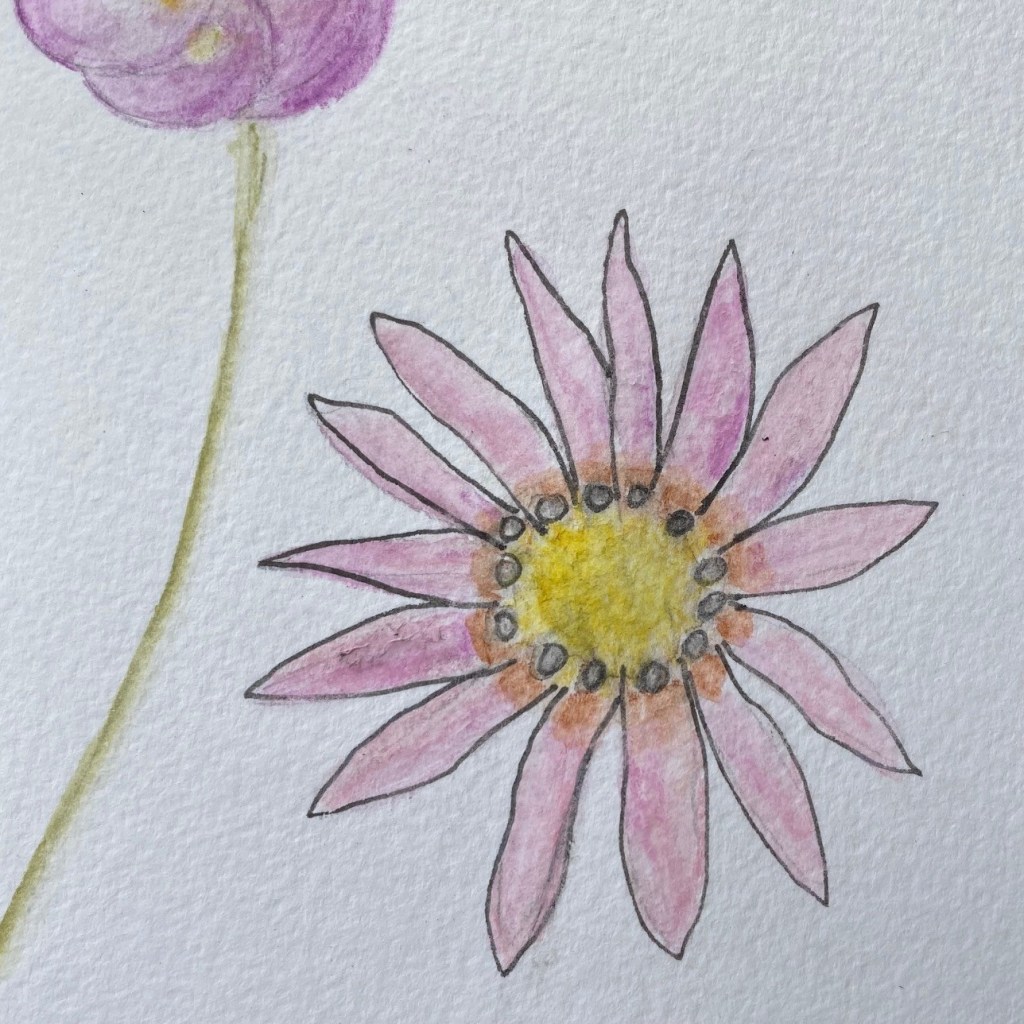
For many plants out back, this tilt is a full commitment. Take the dusty pink flowers with big yellow centers that recently popped up out of the moss-green ground cover: the hundred or so flowers go all in on chasing the sunlight. Their little pink petals cock to the right to get the best position throughout the day, basking in whatever warmth the spring sun provides amidst the fog. At night, they close up their flower shops and wait until dawn to start over again. I waiver between marveling at their ingenuity in getting what they want and thinking it’s slightly pathetic to show so little restraint in making their needs known to everyone else in the garden. 

Huge dinner plate succulents look like flowers but are, in fact, brilliant green leaves shaped into gorgeous florets. I brought these coveted, foot-wide plants into the garden a few years ago when I paid five bucks for three stems to a Chinese-speaking woman I found on Craigslist. We could not communicate with words, and yet we both knew I was getting a good deal. Succulents do best in sun and heat, so their success in reproducing and growing over the years is unsurprisingly supported by their growth toward the path of the sun. Unlike spring flowers, the entire plant has positioned itself in a survival lean to catch as much light and warmth as possible. As an unobjective observer, it appears to me that each stem seems to intuitively know what it needs to be its best self, to have the fullest chance at photosynthesis and survival. 

There are some plants, though, like the sage my friends gifted me from their thriving community garden plot, that seem untethered to the sun’s pattern in the sky. This sage plant took months to settle into its new home, but is now thriving in the middle of the yard in a tall, white pot I purchased to decorate our wedding venue years ago. There’s no lean, no shift to the right – leaves on the shady side look just as firm and delicious as those on the sunnier side of the pot. I love the fair-weather flowers, and I think of those full, healthy, shady side sage leaves as admirable stoics who didn’t get lucky enough to pop up out of the dirt in direct sunlight, but aren’t willing to show how they’re impacted by their distance from the sun. 

As an imperfect gardener, I have likely ignored the little plastic informational sticks from the garden store with scientific plant names and simple caretaking directions like “Full Sun” or “Partial Shade.” Of course, these days, I could download an app and have all of these details at my dirty fingertips. Instead, I prefer to plant each flower or succulent where I want it to grow in the garden and see what happens. This gardening method is not precise, but the concept of surviving where you’re rooted is the throughline in all of my gardening and garden reflections. 

And it works out for the most part. Plants, like humans, do best when they have what they need in terms of sunlight and nutrients, but often make do even when they don’t. Think of weeds growing in sidewalk cracks or gorgeous wildflowers blooming unattended along freeways. Or in my case, flowers and succulents figuring out how to maximize sunlight in my foggy backyard alongside that perfect sage plant in its tall white pot. As I write this, they’re in the garden, leaning toward the sun, living, surviving, growing.
Fear Setting

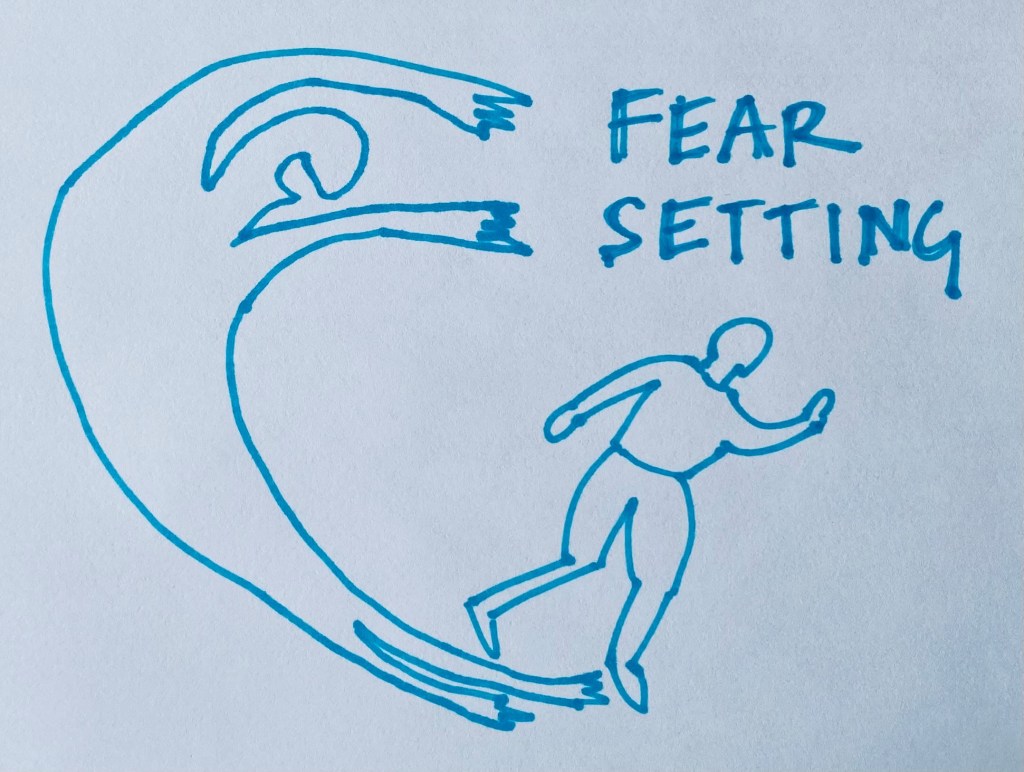
“Fear setting,” as described by Tim Ferriss and others, has been a helpful exercise to reflect on what is holding me back from doing things that feel scary. Recently, my number one scary thing is to start writing for myself again.

In brief, “fear setting” challenges you to write down the worst things that could happen if you take a step toward the scary unknown. You then note what you would do to prevent these worst things from happening, along with what actions you would take if they actually happen. The idea is to write it all out on one piece of paper and see your fears with your reasonable responses next to them. Ideally, it feels not-so-scary on paper. Tim also counsels to list the possible benefits of the action if you take it, as well as a third list of the cost of inaction if you do nothing over 6 months, 1 year, or 3 years.

It is not easy to move from frozen in fear to an embodied knowing that we perceive our scariest challenges blocked by surmountable obstacles. It is harder still to take in Tim’s point that inaction could actually cost us if we don’t attempt the fearful unknown. Especially in creative work, especially when judgement looms as a starting point for fear, even a list of “reasonable” responses to worst case scenarios can feel too fragile to inspire a beginning.

In the spirit of such fragile (re)beginnings, here are excerpts of my own fear setting work around writing again, five years after my last post:

I fear people – in the most generic sense – won’t like me because of what I write. And because I fear this type of critique, I’m disappointed in my interest in external validation in the first place. Although it’s been challenging to admit, I’ve come to understand only recently that I count on external validation to prop up my sense of self-worth. I am a huge fan of Brene Brown and her research on shame, and want to be somebody whose grounded sense of self-worthiness means they can do hard things – even in the face of critics or in the absence of validation. I want to make Brene proud! I say this with only a hint of irony, acknowledging I am not yet this person. So, even though it disappoints me and there’s shame in admitting it, I fear what other people think.

If they read what I write, I fear the people I love will realize I am not a good writer, and worse, that I’m not smart. I fear their judgement mostly as the residue of growing up with an English teacher for a father, who regularly scolded my poor use of grammar and would re-grade my school papers to ensure I knew there was room for improvement, even if the teacher gave me an A. Since my died almost two years ago and is no longer here to comment, there’s only you, dear reader. So, you should know I don’t know what an adverb is off the top of my head. I don’t have a “writer’s vocabulary,” as I am worthless without a synonym search. I make typos, I confuse “there” and “they’re,” and I haven’t used the word “affect” without googling its proper usage in years. 

Deeper down, I fear my own ideas. Because I am committed to a life of learning, I feel it is a truism that I will grow and change my mind on important subjects. Will I disappoint my future self with my elementary thinking now? In my extremely limited experience writing under my own byline, I can answer with assuredness: yes. See this piece from 2013 where I imagined a wedding would “bring up a storm of emotions in both the bride and groom-to-be,” which was an incredibly heteronormative way to make a point about LGBTQ+ rights. Embarrassing. I want to know more in the future than I do now and I want to broaden my mind and how I think, which seems to mean this endeavor carries with it probability that the future me will be disappointed in what the present me writes.

More than a decade ago, I realized that fear of my dad’s judgement was driving many of my life decisions, including my reluctance to write for myself. I sought his approval to confirm my own worthiness, and over the years, internalized his judgments (or rather, my childhood view of them) as my own inner voice and worst critic. In the almost two years since he died, I have come to understand this inner voice lives on, even without him – and thus carries more weight than his. I can tell you this: she’s good at her inner critic job. It’s hard to let go of the role my dad played in my fear of writing, and challenging to realize that retiring my inner critic could take a lifetime. 

Fear setting asks us to shed light on the shadows, anticipate actions to prevent our “worst case” scenarios, and think through what we would do in the event they happen. I’m finally creating space for my fears by dragging them into the light and holding them up as a necessary part of reconnecting with creativity. Brene tells us that “shame derives its power from being unspeakable.” Time will tell if speaking it here unburdens me from the fear of writing, but I did the scary thing and I am still standing.

D.C. Reflections

As most of you readers know, your kind narrator moved from Washington, D.C. to San Francisco, CA earlier this year. Despite the California sunshine and gorgeous views, I miss a lot of my former life in D.C. and never quite adjusted to the cold fog that covers our summer months here in the Bay Area.

Though I’m happy to have created some distance from the long work hours with little effectual policy change, I do miss the people I connected with in our nation’s capital. In addition to my Washington, D.C. friends and colleagues who I think of and miss daily, I reflect equally as often and fondly on an older man who lives down the street from my house of four years in Mt. Pleasant. Strange thing is: I don’t know his name.

This older gentleman sports shoulder-length, questionably-washed silver hair and round, bookish glasses. He almost always wears worn, light denim jeans and Tevas with wool socks. I used to wonder if I liked the looks of him because he reminded me of home. He’s a dog owner, and would walk his three dogs around the block at a snails pace to accommodate one of the oldest, dirtiest terriers I’ve ever seen limp along. Sometimes my silver-haired friend would carry his coffee mug on these unhurried walks – not a to-go cup, but a thick, handmade-by-a-friend-given-as-a-gift mug. Other times, I’d see him chitchatting with neighbors while his dogs would stand patiently waiting at his side.

I’m guessing I saw this guy and his dogs nearly every other day, whether on my way to the Metro or walking home from the grocery store. As much as I was out and about in our neighborhood, he was, too. His unchanging outward appearances and habits helped me formulate a narrative of his life in my head. He was a retired architect, I reasoned, because of the round glasses. But his hands were thick and rough, which meant he spent his youth getting by on odd jobs, working with his hands. Most importantly, I had determined, he was the kind of man who was nice and good and patient with old dogs and hot summers.

About this time last year, when the leaves were finally changing and fall was bringing coolness to the air around us, I saw my neighbor at the church I sometimes attended down the street from our homes. Excited to see him somewhat out of context, I gave him my most earnest smile. He looked as if he had never seen me before and hadn’t the slightest clue who I was or why I was smiling at him.

I remember feeling the sting of disappointment that I wasn’t a memorable face to him like he was to me. But I also felt a sincere appreciation for how I could hold this person in my life with so much closeness—feel truly comforted by his routine and dependability in my life—and simultaneously keep him at arm’s length, never really talking to him or engaging at all beyond a few quiet “hello’s” as I stepped around his dogs on the sidewalk. It was a meaningful relationship for me that was completely unobtrusive, without need or time or work.

A wise friend told me recently that the comfort we seek is often available by observation of the world around us. He likened this quiet observation to a type of meditation, in that taking in your surroundings slows your mind and helps ground you in the present. I wouldn’t claim that watching an older dude walk his dog is any intense meditative work, but I like the idea of finding comfort where you can. And maybe it helps explain at least a little bit of the calmness I felt whenever I saw him around Mt. Pleasant.

As of yet in San Francisco, there is no older gentleman to watch walk his dogs each day. I’ve moved a few times within the city since arriving this spring and suppose I haven’t felt settled enough in one place to fully appreciate my neighbors’ comings and goings. Instead, I watch the trees sway in the wind and the fog roll in over the hills.

Note: this post was first published on fortysevenseventyeight.wordpress.com.

Knowing How We Know

There’s something about the experience of being in my own body that does not translate into being able to figure out what I look like. It’s an odd thing to say, but it’s my lived experience. I suppose that most of the time, I have a pretty good sense of how others see me. I hear feedback about how a dress looks or what friends think of certain jeans. I look at photos or I ask questions. Sometimes, though, I’m completely out of whack despite these inputs.

To be perfectly honest, it’s really just anxiety about my weight. I can’t figure out if I’m twenty pounds heavier than I was last month or only four. If I go on a long run, I am decidedly seven pounds lighter. If I eat Doritos and M&Ms, well, it’s Fatty McGhee for me. Again, clothes fitting any which way doesn’t help, nor does a mirror. I’ve got a skewed self-perception that translates into inconsistency in my own sense of my physical presence. It’s an odd mental block that means I’m challenged in being able to figure out what me looks like through my own eyes.

Understandably, everyone is talking nonstop about Syria. Obama said he wants to respond decisively but needs Congressional approval, and Congress said it’s not yet sure and needs more time on cable news to discuss. Pundits are weighing in, too. Maureen Dowd wrote an interesting piece last weekend about the problem of Syria, where she argued that we’re making a decision about whether to engage in the shadow of Bush’s Iraq war. It’s a pretty simple observation, but an important one in trying to figure out why certain progressive voices are supporting the president and some allies of the Department of Defense are uncharacteristically holding back.

The whole situation feels strange to me because we’re trying to decide the correct course of action while also facing questions about our identity that seem incongruent with how we perceive ourselves as Americans. It’s not abnormal for our leaders to ignore America’s own issues of poverty, hunger, and lack of access over the concerns of a country most of us can’t find on a map. It is odd that they’re talking about what it means to be a superpower, how the world will perceive us, or whether the decision to engage is based on conscience and morals or other, more nefarious incentives.

Perhaps thanks to Bush (!), Americans are less willing to sign off on WMDs meaning a military invasion regardless of the cost or consequence. But if it doesn’t correlate anymore, are we still the greatest country in the world? Are we dependable? Who are we to the rest of the world? More importantly, who are we to ourselves?

I listened to an older episode of This American Life last week that they re-broadcasted for Labor Day weekend as a sort of summer finale. The entire show was a series of stories the reporters put together after spending a few days at a highway rest stop interviewing the staff, people on their way to vacations, etc.—it’s a great show if you have the time.

Toward the end of the hour, Nancy’s Updike’s interview with a middle-aged guy named Dan touched me deeply. Dan was on his way home from spending time with his sons post-divorce and Nancy prodded him to talk about how things had changed for him and his family. At one point in the story, Dan says this about his ex-wife:

She didn’t want me to go to the house to pick the boys up. And then, you know, one week we’re having a good conversation and the next week something like that comes up, and you’re like [GASP]. You have the thing, you want to call that person and yell at them, and talk to them about it, but you don’t have that relationship anymore.

Something about Dan’s last sentiment—about how relationships change so that intimacy and closeness just disappears—it struck a nerve with me. Everyone knows things change, but sometimes you’re not ready for the coldness of the realization because it drains any hope you’d been storing up that things could be different.

Pivots in how we know someone else or even in how we know ourselves aren’t easy. We have to be able to see things accurately, or at least know when our perceptions are colored. Perhaps we can even identify why there’s a hue on our glasses in the first place. We have to be able to answer difficult questions about what change means for our future. And we have to learn to be content with the process itself, whatever the outcome.

Note: this post was first published on fortysevenseventyeight.wordpress.com.

At the Garden

To forget how to dig the earth; to tend to the soil is to forget ourselves.
–Gandhi

I tend to a plot in a community garden nearby my house. It’s about twenty feet long and ten wide—big enough to grow lots of tomatoes, lettuce and kale, and squashes that take over toward the end of summer. This past gardening season, I decided the compost pile in the corner of my plot was less useful than the larger community compost piles scattered on the outskirts of the garden. To make better use of the space in my own plot and put that rich soil to use, I built another raised bed in its place. I’ve got some pretty awesome greens growing there now, and I’m really happy with the added gardening space.

Here’s the thing: over the years of gardening here, I’ve noticed that whenever it rains, little “treasures” make their way to the surface of the soil. Typically this booty is just pieces of glass or bits of old plastic plant identifier tags from years and gardeners past. We’ve had an unseasonably rainy spring and summer here in D.C., and I’ve observed that each time it pours rain, I end up starting my time at the garden literally walking around, picking up bits of whatever has unearthed itself.

This past weekend at the garden was pretty uneventful—weeding, eating some tomatoes off the vine, chatting with a fellow gardener or two. Yet as I was taking out lettuce stalks that had gone to seed from that front compost-turned-bed, and without digging down far at all, I hit three enormous rocks and a big, old white trash bag. I promise, dear reader, that this disgusting trash bag was never in or near my old compost bin. It magically appeared in the ground like some uninvited stranger, just inches below my lettuce. Gross.

There’s an old saying about the importance of cultivating the soil, and how we must tend to it before anything can grow strong and healthy. Maybe I’ve heard this idea offered up in a yoga class before? I’ve taken from this call to cultivate that in life, as in gardening, our foundational building blocks—the earth, our hearts and souls—all of these need tending and fertilizing before anything nourishing can develop. It’s a reminder that just as I dedicate time pulling up weeds and allowing my tomatoes to flourish, I might also carve out time to practice yoga or meditate and allow my inner self the space to thrive.

I’ve kept this metaphor close while picking up bits of glass after our summer rains. It feels more true than not that, without this work to unearth materials that prevent growth—especially with a little help from a passing storm—these pieces of glass might’ve stayed lodged deep in the ground. Like grief or trauma or even a lingering distressing thought, it surprises me how deep those shards may lie beneath the surface of an otherwise beautiful garden. And then, oh what a satisfying process it can be to allow them to surface and be released!

After reading a piece in the NY Times called The Trauma of Everyday Living, I want to extend the metaphor even further and question whether these bits and pieces of human existence that stay with us are just part of the natural ecosystem of a city garden. I appreciate the author’s candor in articulating how deeply we feel painful events, and that even over time, the memory of this grief and trauma is part of our human experience. The earth accepts thrown away glass just as we take on our lived experiences… and after some time, some rain, and some tending, these things pop up—literally or figuratively—and the cycle continues in a different way. After reading this piece, it all feels more natural—and almost preordained—that we cultivate the ground and ourselves to both acknowledge and help release our experiences.

Except what was that gross plastic bag doing in my compost pile garden? It didn’t belong, I didn’t put it there, and I didn’t want it there. Seeing a petroleum-laden, big white bag near my lettuce was a punch in the face to this nice imagery of tending to a thriving garden and spiritual life… What if the gardening, tilling, weeding—the yoga, meditation, acceptance and kindness work—what if all of that means the equivalent of an old plastic bag will unearth itself over time?

I rely on those more awakened than I am to answer that this tending and heart work is messy, and to thrive, we have to be open and ready to dig up the equivalent of trash bags in our gardens or our past experiences. Nobody would ask to do it. It isn’t fun and it can be painful without much reward. No doubt it’s a tough job to work with and clean up the tough, gross stuff. As gardeners, we have little choice.

Note: this post was first published on fortysevenseventyeight.wordpress.com.

Shake the Sleeping Baby

The last few weeks have been busy in Washington, D.C. The Senate passed a comprehensive immigration reform bill, the Supreme Court issued some really fantastic and some not so great decisions, and I spent my spare time making table decorations for my best friend’s wedding. All of this wall-to-wall action got me thinking about the question of calling the question: how does one know when it’s the right time to make the big ask, intervene, or give a situation a gentle push.

During the wedding planning, my friends and I joked that asking certain questions of the bride-to-be was like shaking a sleeping baby—the plain dumbest idea ever. In other contexts, however, it feels like some babies need to be shaken in order to make good progress. I’m speaking metaphorically, of course, but upending the status quo does cause discomfort… and I suppose it could be said that ignorance is as akin to sleeping as social movements are to shaking someone awake.

The phrase “shit or get off the pot” comes to mind as a more direct way to describe this calling of the question. Depending on one’s line of work, my sense is that thoughts on calling the question vary widely, as does how the question itself is framed.

For example, many high profile LGBT rights advocates were actually pretty upset when the Prop 8 case was pushed toward the Supreme Court (by two straight dudes, by the way). Many thought it was not the time to press for a SCOTUS decision, and that waiting for the arch of the moral universe to bend just a little bit more toward justice was the most prudent course. In this instance, the naysayers and supporters alike within the LGBT policy community rallied behind the marriage fight to support the case they didn’t think could be won. In the end (though it’s really just the beginning), the SCOTUS denied standing in Prop 8 and we didn’t get the big ruling. It was a win, though, as was the work done by advocates who did not necessarily sign off on the effort in the first place.

Immigration advocates, on the other hand, seemed to be of one mind on the path forward in their fight for comprehensive immigration reform: the 2012 elections provided an opening for bipartisan action and if it didn’t happen early in President Obama’s second term, momentum would be lost. Of course, nothing is ever simple, and there were serious misgivings about how much could be compromised in order to get a bipartisan bill passed through the Senate. Family reunification was the goal for most of these advocates, but border security would be the high price to pay. Think moving the resources out of Afghanistan and straight to our southern border—earmarks to military contractors and fence builders. When it came down to the final bill that passed the Senate, calling the question became a matter of how much immigration advocates could stomach to get what they wanted.

Luckily, wedding table decorations are way less contentious than immigration reform or marriage equality. Weddings do, however, bring up a storm of emotions in both the bride and groom-to-be, as well as their families. I had the opportunity to view these emotional family dynamics as an outsider, and perhaps because of this, was able to see the full spectrum of interactions. Trying to figure out how best to support my friends and engage with their family members who needed a little steering got me thinking about human interactions, and how we decide when to plug in—when to challenge people, when to let things go, and how to approach a positive critique in the name of moving something forward rather than stagnating a relationship you care about.

When it comes down to it, many facets of life are tied up in these same issues. Whether it’s a wedding or a civil rights march, you have to decide when to push and how hard, when to lay off for the time being, and when to walk away. Perhaps this choice is the blessing and the curse of progressive organizing. There’s always a baby to shake, and there are always consequences of shitting on the pot.

Note: this post was first published on fortysevenseventyeight.wordpress.com.